
«Over years of analysing the iGaming industry, our editorial team has tested dozens of educational approaches. The main conclusion: safety for the audience in Bangladesh starts not with picking a random roulette site, but with a deep understanding of wheel mathematics, RNG fairness verification and careful limit control.» — Nadia Farzana Haq, Chief Editor of Sports & iGaming Events, iGaming Bangladesh.
What this guide covers:
- Rules & mechanics:how a round works from bet placement to payout, including a full table of payouts for every bet type.
- European vs American roulette:why a single zero saves you money long-term (2.7 % house edge vs 5.26 %).
- Formats compared:live roulette (with Lightning and Speed variants), auto roulette and demo mode — which fits your goal.
- Casino evaluation:a four-point checklist to verify licences, RTP and bonus fairness before depositing.
- Responsible gaming:common mistakes, the Martingale trap and why demo modes with inflated RTP can distort real-play behaviour.
 platforms demands strict discipline and a solid understanding of the rules. In 2026, roulette onli](/media/betjilibd_login_com_media_text_section_4_media_image_85ea9592_c7bb_47c7_93e1_0d90b642a920_b6cfdd9dd8.webp)
Transitioning from traditional sports such as cricket to online casino platforms demands strict discipline and a solid understanding of the rules. In 2026, roulette online is a sophisticated ecosystem where certified algorithms coexist with studio-quality live broadcasts. This guide works as an objective knowledge base — not a sales pitch. We break down how the mechanics work, explain why your choice of wheel variant directly affects expected value, and outline which criteria matter when evaluating platforms. The goal is straightforward: help you minimise financial risk and protect your deposit.
«Virtual roulette is the most popular online casino game outside of slots: 36 % of active players placed roulette bets in the preceding 12 months.» — Gambling Commission, Key findings on online casino games excluding slots, 2024. https://www.gamblingcommission.gov.uk/report/key-findings-on-online-casino-games-excluding-slots

What roulette is and why players choose it online
Roulette is a game built around a spinning wheel and a ball. The player's task? Predict the sector where the ball will land. That's it — at its core, roulette is a game of pure chance dressed in elegant mechanics. Online roulette differs from its land-based ancestor by offering instant browser access, lower minimum limits and a variety of formats that no physical venue could realistically accommodate.
Worth noting: among casino games, roulette occupies a unique position. It blends simplicity with depth. You can play roulette with a single colour bet or construct elaborate multi-position strategies across the entire table. That flexibility is precisely why the format thrives in the roulette online casino environment.
Quick-reference glossary of core roulette terms:
- Roulette:A classic casino game where the outcome of bets is determined by a spinning numbered wheel.
- Roulette wheel:A mechanical or virtual device with numbered, coloured pockets that produces each round's result.
- Roulette table:A layout with marked zones where chips are placed before the spin.
- Dealer (Croupier):The person (in live roulette) or algorithm (in digital roulette) who manages the game, accepts bets and handles payouts.
- Ball:A small object whose random trajectory determines the winning number.
- Chips:Gaming tokens representing real money on the table.
- Bets:Wagers placed on specific numbers, groups of numbers or properties (colour, parity).
- Dolly (Marker):A special marker the dealer uses to indicate the winning number on the table after each spin. In live-dealer games, the dolly is placed before any chips are cleared or paid.
- Rake:A croupier's tool — a long stick — used to collect losing chips and distribute winnings across the table efficiently.

Why roulette online is popular with new and experienced players
Several practical factors explain the surge in popularity of online roulette. And honestly, most of them come down to convenience rather than anything exotic.
- No download required. Browser-based play removes installation barriers on both mobile and desktop devices. You open a tab, pick a table, and you're in.
- Demo modes. Most licensed platforms let you practise with virtual chips — zero financial risk while you learn the roulette game flow.
- Table variety. Online lobbies host dozens of roulette games (European, American, French, live-dealer tables), whereas a typical brick-and-mortar casino is limited to a handful of physical tables.
- Instant seat availability. No waiting for a free spot. Online tables are virtually unlimited, so you can play roulette whenever the mood strikes.
For players in Bangladesh who are more familiar with cricket betting markets, the transition to roulette online can feel surprisingly natural. Both require understanding odds, managing stakes and — above all — knowing when to step away.
Roulette game basics in one view
What makes a roulette game approachable for a complete beginner? The answer lies in its visual clarity. The wheel shows you every possible outcome. The table layout maps directly to those outcomes. Chips represent your stake. The dealer — human or digital — runs the process. And the ball does the rest.
Unlike card games where hidden information creates complexity, roulette puts everything on display. That transparency is both its appeal and, perhaps, its danger: the simplicity can make players underestimate the mathematical edge built into every spin.

How an online roulette game works from spin to result
A standard online roulette round — from opening the table to having winnings credited — takes between 15 and 30 seconds. In the digital format, a certified random-number generator (RNG) is entirely responsible for producing the result, which eliminates human influence. The RNG system selects a random integer within the wheel's range and maps it to a specific pocket. Every spin is statistically independent of the one before it. No exceptions.
Stages of an online roulette round:
- Table selection — choose your limits and wheel type (European, American, etc.).
- Bet placement — place chips on the layout before the countdown expires.
- Spin — the wheel is launched by the dealer (live) or the RNG engine (digital).
- Result — the ball settles and the winning number is recorded.
- Settlement — the system calculates payouts automatically and credits your balance.


The roulette wheel, ball and dealer in live and digital formats
The difference between live roulette and the automated format lies in the nature of randomness itself. Digital tables use a cryptographically secure pseudo-random number generator (CSPRNG) verified against GLI-19 standards. Live versions, on the other hand, rely on the physical mechanics of friction and ball trajectory — real physics, real unpredictability.
In digital games, the dealer's role is performed by software whose objectivity is confirmed through regular audits by laboratories such as iTech Labs or eCOGRA. Independent labs conduct statistical uniformity tests on both RNG outputs and live wheels. For live formats, they additionally check for systematic bias caused by wheel wear or dealer manipulation.
Here's something worth considering: many players instinctively trust the live format more, even though the RNG version is arguably more rigorously tested. Visual transparency creates a powerful psychological anchor.
«Certified random-number generators ensure outcome independence; however, the physical wheel in live broadcasts traditionally inspires greater player trust through visual transparency.» — Industry analysis of e-Gaming fairness systems, 2024.

How to place a bet on the roulette table
To interact with the roulette table, select a chip denomination from the graphical panel (common values: 0.10, 0.25, 1.00, 5.00, 25.00) and click on the corresponding zone. The system allows you to combine a straight-up bet — clicking directly on a single number — and a split bet — clicking on the border between two adjacent numbers — within a strict time window. The interface locks with a "No more bets" announcement.
Before confirmation, you can undo or clear any placed chips using the Undo/Clear buttons. This is a small detail that saves real money: a misplaced chip on a live table with a ticking countdown can cost you if you don't know where the undo button sits. Practise this in demo mode first. Seriously.
Roulette table layout and the main bet types
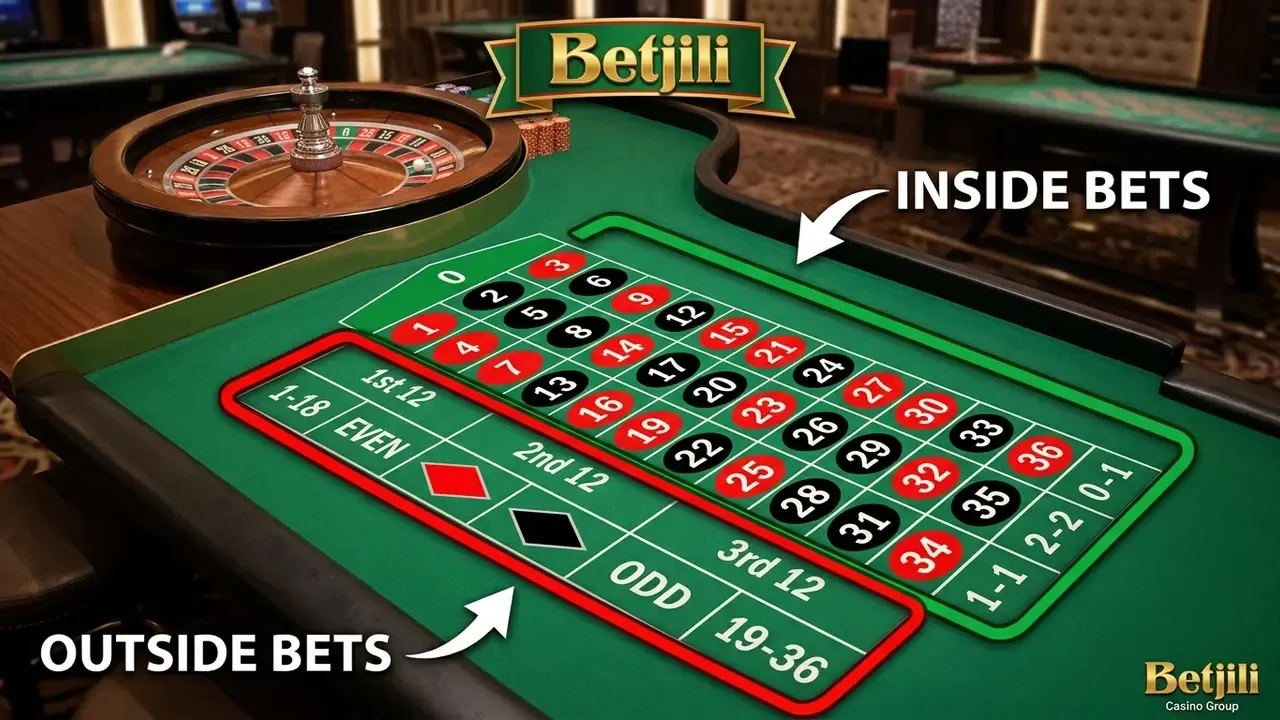
The roulette table layout is divided into an inner zone (inside bets) containing individual numbers and an outer zone (outside bets) with broader probability groups. This division lets you balance risk quickly — aggressive single-number wagers on one end, conservative colour or sector predictions on the other.
Inside bets: from straight-up to six line
Inside bets involve placing chips within the numbered grid (0–36) on a specific number or at the border of adjacent numbers. These bets carry higher volatility and correspondingly higher payouts. Think of them as the "high-risk, high-reward" territory of the roulette table.
| Bet type | Numbers covered | Payout | Probability (European) |
|---|---|---|---|
| Straight Up (single position) | 1 | 35 : 1 | 2.70 % |
| Split (double position) | 2 | 17 : 1 | 5.41 % |
| Street | 3 | 11 : 1 | 8.11 % |
| Corner / Square | 4 | 8 : 1 | 10.81 % |
| Six Line (Double Street) | 6 | 5 : 1 | 16.22 % |
Example: A $10 Straight Up bet on number 17 that wins returns $10 + $350 = $360. A $10 Corner bet covering 1-2-4-5 that wins returns $10 + $80 = $90. The difference in payout reflects the difference in probability — nothing more, nothing less.
Outside bets: red, black and broader betting options
Outside bets sit along the perimeter of the number grid and cover large groups of outcomes — red/black, odd/even, high/low (1–18 or 19–36), dozens and columns. The win probability for even-money bets in European roulette is approximately 48.6 % (18 out of 37 pockets). Close to a coin flip, but not quite — and that gap is where the house edge lives.
| Bet type | Numbers covered | Payout |
|---|---|---|
| Red / Black | 18 | 1 : 1 |
| Odd / Even | 18 | 1 : 1 |
| High / Low (19-36 / 1-18) | 18 | 1 : 1 |
| Dozens (1st 12, 2nd 12, 3rd 12) | 12 | 2 : 1 |
| Columns | 12 | 2 : 1 |
Responsible-gaming experts strongly recommend these broader betting options for beginners because they reduce deposit variance and prevent rapid bankroll depletion during losing streaks. As GambleAware's educational materials note, wider bet zones help players sustain their bankroll at lower risk of large single-round losses. If you're new to the roulette game, starting here makes practical sense.
European roulette vs American roulette: what changes for the player
The fundamental difference between European roulette and American roulette is a single extra pocket — the double-zero (00). That one pocket roughly doubles the casino's mathematical advantage while keeping payout ratios identical. Choosing the right wheel variant is a foundational step, and it should happen before you deposit. The American version simply takes more of your money over time.
| Feature | European roulette | American roulette | Player impact |
|---|---|---|---|
| Number of pockets | 37 (0, 1–36) | 38 (0, 00, 1–36) | Extra pocket lowers win probability |
| Zeros on wheel | Single zero (0) | Double zero (0 and 00) | Double zero increases the operator's edge |
| House edge | 2.7 % | 5.26 % | American roulette costs nearly twice as much long-term |
| Special side bet | None | Five-number bet (0, 00, 1, 2, 3) | This American-only bet carries a punishing 7.89 % house edge |
Concrete example: On a European wheel the expected loss is 2.7 % of your stake per spin. On an American wheel it is 5.26 %. Over 1,000 spins at $10 each, that difference amounts to roughly $256 in additional losses on the American table. That's not a rounding error — it's a meaningful chunk of bankroll.
Disclaimer: The information in this section is general in nature and does not replace professional advice. Gambling involves financial risk. Verify the current gambling legislation in Bangladesh before participating in online games.

European roulette and why it is the default choice for many players
European roulette is considered the default format because of its optimal theoretical return (RTP) of 97.3 %, which aligns with the strict consumer-protection standards of European and international regulators such as the Malta Gaming Authority and the UK Gambling Commission. In the EU, more than 90 % of roulette tables — across both live-dealer and RNG categories — are deployed in the European single-zero configuration. American and other variants make up less than 10 % of the offering.
For players in Bangladesh exploring roulette online for the first time, this matters. When you see a lobby full of options, the European wheel should be your starting point. Not because it guarantees wins — nothing does — but because it gives you the best mathematical footing available.

American roulette and the role of the extra double structure
The American roulette layout features a wheel and table with 38 pockets, including the additional green 00 sector. This extra pocket increases the probability of a loss on even-money bets and raises the house edge to 5.26 %, making the variant statistically disadvantageous compared to its European counterpart.
The so-called five-number bet (0, 00, 1, 2, 3) — exclusive to this version — compounds the financial burden with a dealer advantage of 7.89 %. Most experienced players avoid this particular wager entirely. If you do play roulette on an American wheel, at least steer clear of that specific bet. It's the worst odds on any standard roulette table.
Live roulette, auto roulette and demo roulette: which format fits your goal
Your choice of online roulette format — from live roulette with a human dealer to a risk-free demo — depends on whether you seek social immersion, high-speed play or a safe testing ground. Each format serves a different purpose, and understanding that distinction matters more than most players realise.
| Format | Primary goal | Round speed | Social element |
|---|---|---|---|
| Live roulette | Real-casino atmosphere, trust via transparency | 45–90 seconds | Dealer interaction, player chat |
| Auto roulette (RNG) | Maximum throughput, solo efficiency | 10–30 seconds | Minimal or none |
| Demo roulette | Learning rules, interface practice | Same as base version | None |

Modern live roulette variants: Lightning, Speed and beyond
Beyond the classic live broadcast, providers now offer innovative formats that attract both new and veteran players:
- Lightning Roulette adds random multipliers (50× to 500×) to Straight Up bets each round, combining the social feel of live play with dramatically higher payout potential. The game won Product Innovation of the Year at the Global Gaming Awards (G2E Las Vegas) and EGR Game of the Year 2018.
- Speed Roulette compresses the round to roughly 25 seconds — about 50 % shorter than a standard live round — suiting experienced players who prefer a fast pace. Betting occurs only during the spin, which demands quick decisions.
- Auto Roulette removes the live dealer entirely, using a precision-engineered automated wheel. Speed Auto Roulette handles up to 2,500 games per day, and the format is available in European, French and American configurations.
- Immersive Roulette uses multiple camera angles and a slow-motion replay of the winning number, placing the player as close to the action as technically possible.
A quick observation: Lightning Roulette in particular has reshaped how players think about live roulette. The multiplier mechanic adds a layer of excitement, but it also subtly shifts the payout structure. The base Straight Up payout drops from 35:1 to 29:1 to fund those multipliers. Worth knowing before you get dazzled by the lightning bolts.

When to choose roulette demo before real play
A roulette demo mode should always precede launching an unfamiliar table. It lets you explore the rules, master the interface and understand how bets are placed — all without financial risk. Three key scenarios where demo play is genuinely essential:
- First encounter with a new variant (e.g., French roulette's La Partage rule) — practise the rule differences before staking real money.
- Learning a new platform's interface — rehearse chip placement, limit settings and Undo/Clear buttons to avoid mis-clicks under pressure.
- Transitioning from land-based to online — adjust to the speed of digital rounds, automated settlement and the absence of a physical dealer.
Disclaimer: Demo modes do not reflect the real probability of winning in a real-money game. The information here is provided for educational purposes only.
A critical caveat, though: laboratory experiments on player behaviour have demonstrated that demo versions with artificially inflated RTP can provoke more aggressive betting when players switch to real-money mode. The confidence you build in demo doesn't always translate accurately.
«Participants who played free-play modes with artificially inflated wins placed significantly higher bets during the real-money stage, even though session duration did not differ.» — Controlled laboratory study on the influence of free-play modes on subsequent wagering, PubMed, 2023. https://pubmed.ncbi.nlm.nih.gov/
What live roulette adds compared with standard online roulette
Live roulette provides an atmosphere with a real dealer, a physical wheel and a video broadcast, creating a level of trust that standard RNG games cannot quite match. According to the Gambling Commission, live roulette was chosen by 29 % of active online casino players in the preceding 12 months — a figure comparable to online poker.
Gambling Commission, Key findings on online casino games excluding slots, 2024. https://www.gamblingcommission.gov.uk/report/key-findings-on-online-casino-games-excluding-slots
The round speed of 45–90 seconds encourages a more measured pace of play. However — and this is important — the presence of a live chat, visual triggers and the social energy of other players demand genuine emotional discipline within a responsible-gaming framework. The immersion that makes live roulette appealing can also make it harder to walk away.
 offer should rely on documented evidence of fairness, transparent limits and a heal](/media/betjilibd_login_com_labeled_list_39_media_image_455a89ee_ce2b_49d4_9fa6_3eddd085ccf6_70b4f95168.webp)
How to evaluate a roulette casino offer before you play
Evaluating a roulette casino offer should rely on documented evidence of fairness, transparent limits and a healthy selection of European roulette tables. Promises of guaranteed profit are a red flag — always. Assess offers strictly through the lens of legal compliance and user protection.
Fact-check checklist for players from Bangladesh:
- Check 1:Valid licence from MGA, UKGC or another recognised supervisory authority.
- Check 2:Presence of European roulette tables (RTP ~97.3 %).
- Check 3:Published RNG audit results from iTech Labs or eCOGRA.
- Check 4:Realistic wagering requirements on bonuses (around 30–40×; roulette games often contribute only 10–20 % of each bet towards wagering — a detail many players overlook).
A pilot study on pop-up warnings in a simulated online roulette environment found that loss-framed messages did not significantly reduce player spending. That's a sobering reminder: self-imposed limits and bankroll discipline remain more effective than passive notifications.
Pilot study on pop-up warnings in simulated online roulette, 2023. https://pubmed.ncbi.nlm.nih.gov/
Signs of a strong roulette online casino page
A quality lobby page features detailed table filtering with clear separation of live roulette and digital formats, along with visible minimum limits and technical RTP for each game. Native navigation allows seamless switching from a demo table to a real-money table without intrusive pop-ups.
Look for provider-based filters, stake-range displays and one-click access to game rules. If a roulette online casino buries its RTP data or makes it difficult to find table limits, that's not a good sign. Transparency in the lobby usually reflects transparency in operations.

Which roulette games are worth trying first
The safest start is a digital European roulette game, where the player fully controls spin timing and has unlimited thinking time. Transition to live roulette only after cementing your knowledge on a virtual table, because the studio timer will not pause for hesitation.
French roulette — with the La Partage rule that returns half your even-money stake when zero hits — is another excellent beginner choice. It reduces the effective house edge to approximately 1.35 %, which is the lowest you'll find on any standard roulette table. Not every platform offers it, but when you spot it in the lobby, it's worth a closer look.
Roulette rules that matter before your first session
The fundamental rules rest on one principle: each spin is a completely independent event. Any attempt to cover the entire layout with chips is mathematically doomed because of the house edge. To protect your funds, understand the bet-locking procedure and maintain strict bankroll discipline. No shortcut around this.
«A four-wave longitudinal study found that online casino play is one of the strongest predictors of transitioning to at-risk gambling status.» — "Colliding Harms" longitudinal study (gambling and gaming intersection), 2023–2024. https://pubmed.ncbi.nlm.nih.gov/

The minimum rules to know before placing chips
The key rule: bets can be placed or adjusted only until the dealer (or system) announces "No more bets." After that announcement, the interface locks and any further clicks are rejected. Every chip placed on the layout is committed to the round; if the prediction is correct, the payout is credited automatically.
Quick responsible-gaming checklist before every session:
- Set a session time limit (e.g., 30 minutes) and stick to it.
- Never wager more than 5 % of your total bankroll on a single round.
- Use the platform's built-in deposit and loss limits — configure them before you start.
- Walk away after hitting your pre-set loss ceiling. Never chase losses.
That last point deserves emphasis. Chasing losses is the single most common path to problem gambling behaviour. If you remember nothing else from this guide, remember that.

Common mistakes new players make at the table
The most destructive mistake is confusing single and split positions on the roulette table, followed by the temptation to "chase" losses through the Martingale system — doubling after every loss until the table limit or your bankroll stops you. Equally damaging is ignoring the fact that red and black sectors do not "remember" previous outcomes. This is the gambler's fallacy, and it catches even experienced players off guard.
Other frequent errors:
- Skipping demo practice. Jumping straight into live tables leads to panicked mis-clicks when the countdown timer pressure kicks in.
- Ignoring table limits. A bet below the minimum or above the maximum is automatically rejected, wasting precious seconds in a live round.
- Emotional betting. Letting frustration override logic after a losing streak consistently amplifies losses. If you feel the frustration building, close the tab. The table will still be there tomorrow.
FAQ about online roulette before choosing a game
Respuestas renderizadas en formato acorde al diseГ±o exportado: tarjetas oscuras, acento dorado y despliegue compacto.
1 Is roulette demo enough to learn the table before real play?
Is roulette demo enough to learn the table before real play?
A demo mode fully covers the learning of probabilities, rules and zone layout, but it cannot prepare your psychology for the pressure of real-money play. The emotional shift when risking your own capital often overrides strategic thinking. So after demo practice, begin with absolute micro-limits — say, $0.10 per bet — and scale up gradually only when you feel genuinely comfortable. Rushing this transition is one of the most common and costly mistakes.
2 Which is better for beginners: live roulette or digital European roulette online?
Which is better for beginners: live roulette or digital European roulette online?
For a new player, digital European roulette online is objectively safer because it lets you control the spin button yourself, giving unlimited time to analyse the table without rigid studio timers. The live format adds a powerful sense of presence, but the need to rush decisions raises the percentage of technical errors among inexperienced users. Start digital, move to live once the mechanics feel second nature.
3 What is the minimum deposit for online roulette?
What is the minimum deposit for online roulette?
Minimum deposits vary by platform and payment method. Most licensed casinos accept deposits starting at $5–$10. Table minimums for digital roulette can be as low as $0.10 per round, making it accessible even on a very small bankroll. Always verify limits in the lobby before playing — and remember that bonus wagering requirements can effectively lock your funds if you don't read the terms carefully.
4 Is online roulette legal in Bangladesh?
Is online roulette legal in Bangladesh?
Bangladesh's gambling laws are complex and evolving. Before participating in any online casino activity, players should review the current provisions of the Public Gambling Act and consult local legal guidance. Licensed international platforms operate under the jurisdiction of bodies like the MGA or UKGC, but local legality remains the player's responsibility. We cannot provide legal advice — only encourage you to seek it.
5 Can I use the Martingale system to guarantee a win?
Can I use the Martingale system to guarantee a win?
No. No betting system can overcome the house edge mathematically. The Martingale strategy — doubling your bet after each loss — works only with an infinite bankroll and no table limits. Neither of those exists in practice. A single prolonged losing streak can wipe out a session's budget in minutes. Treat every system as a bankroll-management preference, not a path to guaranteed profit. The maths doesn't care about your strategy.
Editorial note: Content is provided for educational purposes. Persons under 18 are not permitted to gamble. Review local legislation in Bangladesh and do not treat casino gaming as a source of stable income. If you or someone you know is affected by problem gambling, seek support from a qualified professional or a helpline in your jurisdiction.
Last updated: July 2026