
"As we develop a sports-first portal for the Bangladesh audience, we constantly analyse the online gaming industry. The main conclusion: poker is a discipline built on mathematics and positional strategy, not blind luck. Start by studying the rules, respecting local laws and using free simulators — minimising any financial risk." — Nadia Farzana Haque, Editor-in-Chief, iGaming Bangladesh
Over the long run, mathematical skill — not luck — determines a player's results in online poker. That distinction matters more than most newcomers realise.
"Statistical analysis of online hands shows: as the number of played sessions grows, skill increasingly dominates over variance in determining outcomes." — "Online Poker and Rummy — Games of Skill or Chance?", arXiv preprint, 2023
Important notice: This content is for informational and educational purposes only. Gambling is strictly for persons aged 18 and over. Always check the laws of your country and remember that play never guarantees financial profit. This article does not constitute financial or legal advice. Online gambling may be restricted or prohibited in your jurisdiction.
Key Takeaways
- Poker is a mathematical game; luck fades over large samples of hands.
- Begin with free-play tables before risking real money.
- Memorise the ten standard hand rankings before sitting at any real-money table.
- Fixed-limit games are the safest format for beginners.
- Responsible bankroll management is more important than any single hand.
What Poker Is and Why Players Choose Poker Online
At its core, poker is an intellectual card game where participants compete against each other for a pot. They rely on mathematical probabilities, strategy and psychology — not house odds. The format of online poker has become a global standard thanks to round-the-clock availability of micro-stakes and software that automatically counts the pot and determines the winner. For new poker players, the digital environment offers a genuinely safe start: the option to use free poker without any financial outlay.
Worth noting: online poker is engaging enough to produce measurable changes in the brain's reward-related processes, even among experienced players.
"Online poker triggers neurophysiological responses tied to reward circuits comparable to real-money gambling." — "Impact of online poker gambling on behavioural and neurophysiological responses to a virtual gambling task", Addiction Biology, 2024
Online poker versus live play at a physical table
| Criterion | Poker online | Live (offline) play |
|---|---|---|
| Accessibility & convenience | 24/7 access from anywhere; dozens of micro-stake levels. | Requires travel to a club; hours set by the venue. |
| Speed of play | High: automatic dealing and pot calculation. | Low: manual shuffling, physical chips. |
| Cost to start | Free-play (poker free) or penny stakes available. | Higher minimum buy-ins plus travel costs. |
| Learning tools | Built-in hand-strength prompts and equity calculators. | No software assistance; mental arithmetic only. |
Bottom line: Online poker dramatically lowers the entry barrier. It provides an automated environment for learning poker rules without social pressure or the need to handle physical chips.
Want to try poker risk-free? The iGaming Bangladesh platform offers free practice tables and freerolls — start with zero deposit and learn game mechanics in a safe setting.
What Makes Online Poker Convenient for New Poker Players
The key convenience of the online environment is automation. New poker players choose to play poker online because the software handles pot-size calculation, determines hand seniority at showdown and controls the order of action — all tasks that would otherwise require a human dealer and mental arithmetic. The availability of free poker modes removes the psychological barrier entirely. Users can master fundamentals without risking a single taka or dollar.
There is another practical advantage people rarely mention: multi-tabling. Online, you can open two or three tables simultaneously, which accelerates learning by compressing experience into a shorter timeframe. In a live casino, you are limited to roughly 25–30 hands per hour. Online, that number jumps to 60–80 per table — or more.
How a Poker Game Differs from Other Card Games
The main difference between poker and blackjack or baccarat? Poker is a player-versus-player contest, not a game against the house. Every poker game is a discipline of incomplete information: cards are dealt randomly, but decisions about whether to bet, raise or fold depend entirely on the person sitting behind the screen.
"As the sample of hands increases, skill progressively dominates over chance in determining a player's net result." — "Online Poker and Rummy — Games of Skill or Chance?", arXiv preprint, 2023
Courts and regulators in several jurisdictions — including certain EU member states and US states — formally classify poker as a skill game. They separate its regulation from pure games of chance like roulette or slot machines. That legal distinction reflects a mathematical reality: in poker, your decisions shape the outcome far more than the cards you receive.
Poker Rules Every Player Should Know Before They Play
Basic poker rules govern the order of action at the table, how the prize pool is formed and the principles for determining a winner. In a standard game, each player pursues one goal — to win the pot, which is built from voluntary and compulsory bets. A player can win by showing the strongest card combination at the final showdown, or by forcing every opponent to fold through an aggressive bet.
That sounds simple. In practice, the interplay of position, stack sizes and opponent tendencies creates layers of complexity that keep the game interesting for decades.
Observational data from real online rooms reveal that the majority of players place small bets and play irregularly, while a minority demonstrates intense activity.
"Most online poker participants wager modestly and play infrequently, whereas a small subset accounts for a disproportionate share of total action." — "A Contemporary Study of Actual Online Poker Activity", Addiction Research & Theory, 2022
The Table, Dealer, Cards and Chips in a Standard Poker Game
A standard poker table seats 6–9 participants who use a French deck of 52 cards (no jokers) and chips of various denominations. The dealer position (marked by a button) moves clockwise after every hand, determining the order of action and the placement of the compulsory blind bets. The virtual dealer in an online game instantly deals cards and moves chips, guaranteeing fairness through RNG (Random Number Generator) algorithms.
In addition to blinds, many tournament formats charge an ante — a mandatory contribution from every player at the table before cards are dealt. The ante accelerates action by increasing the starting pot size, especially on later levels of a tournament. Think of it as a small tax that keeps everyone engaged: without it, tight players could simply wait for premium hands indefinitely.
Betting Rounds and the Action in Poker
Every hand is divided into betting rounds during which each player reacts to opponents' actions. Trading happens strictly in turn: players evaluate the strength of their hands and place bets. If nobody has bet before you, you may pass (check) or open with a bet; if a bet already exists, you can match it (call), increase it (raise) or discard your cards (fold).
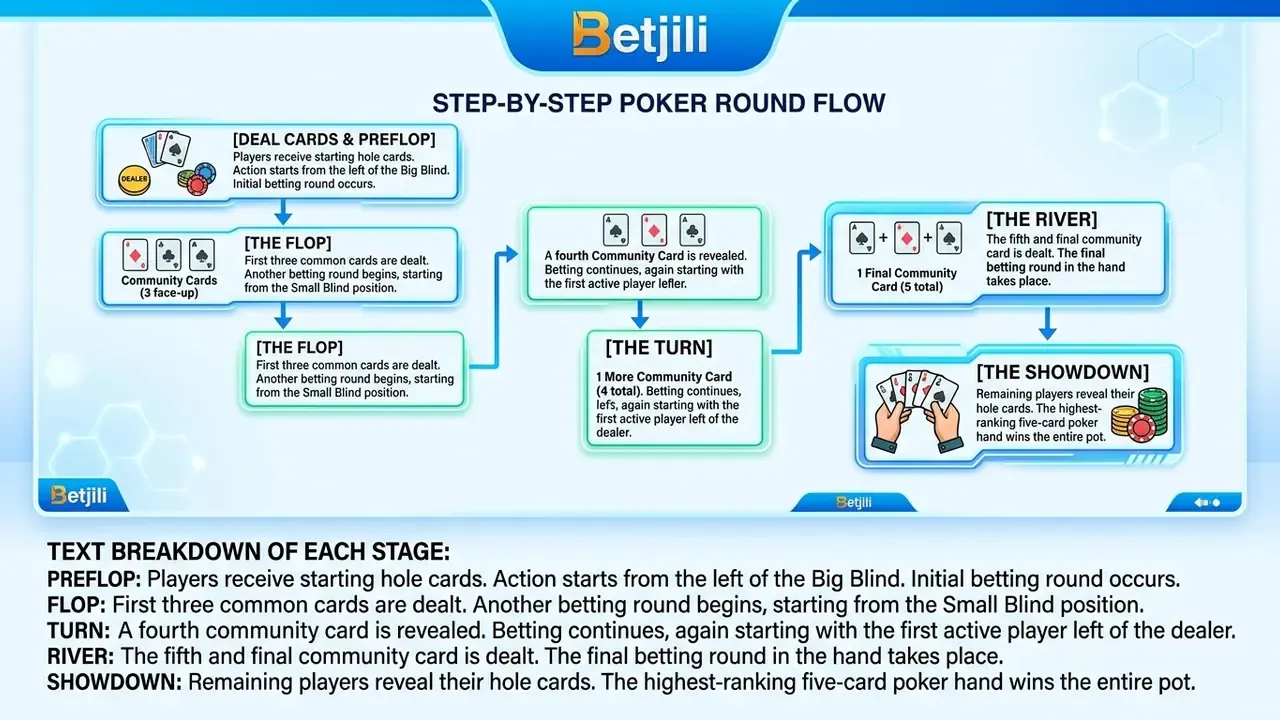
(Placeholder: Flowchart with stages — Preflop → Flop → Turn → River → Showdown. Detailed step descriptions are integrated into the next section.)
How to Play Texas Holdem Poker Step by Step
To master Texas Holdem poker, memorise the structure of four streets (rounds) of betting: preflop, flop, turn and river. This is the most popular variant of holdem poker, where players work with two hole cards and five community cards to assemble the best possible final hand.
Poker Texas Hold'em has also become the benchmark environment for artificial-intelligence research, confirming its status as a strategically rich discipline rather than a game of chance.
"AI agents trained on Texas Hold'em have reached near-optimal strategies, underscoring the depth and mathematical rigour of the game." — Research on computer poker agents and game theory (sources: Carnegie Mellon / University of Alberta AI studies)
How a Texas Holdem Hand Starts and Develops
A hand in Texas Holdem begins when each player receives exactly two face-down cards (hole cards), followed by the first round of betting (preflop). The dealer then lays out three community cards — the flop — after which another round of betting takes place. Next comes the fourth card — the turn — and finally the fifth — the river. The structure of Texas Holdem forces participants to continually re-evaluate their hand as new information appears on the board.
Example of a real hand: Suppose Player A holds A♠ K♦. Preflop, they raise. The flop comes K♠ 7♣ 2♥ — Player A now has top pair with the best kicker. An opponent shoves all-in. Player A calculates pot odds, considers the possible hands the opponent could hold, and decides to call. The turn is 4♦, the river 9♣. At showdown the opponent reveals Q♠ J♠ — nothing but a missed draw. Player A wins with a pair of Kings, Ace kicker.
Notice what happened there: the outcome was not about luck. Player A made a mathematically sound call based on the range of hands the opponent could reasonably hold. That is poker in a nutshell.
What a Player Does During Each Betting Round
In any betting round the task of a poker player is to choose the mathematically correct action: fold, check, call, bet or raise. The decision depends directly on the limit structure of the table, the player's position and the size of the current pot. Action always passes clockwise, so players in late positions enjoy an informational advantage over those who act early.
"Research on decision-making under uncertainty confirms: additional information improves choice quality, and late position in poker is its primary source." — Game-theory and poker-algorithm research (sources: Carnegie Mellon / University of Alberta)

Fact Check: Beginners often mistakenly believe that Texas Holdem is the only type of poker that exists. Not true. Other popular variants include Omaha, Stud and Draw poker. In Draw Poker, all cards are dealt face-down to the players and they may exchange some for new ones. In Stud Poker, some cards are dealt face-up as the betting progresses, so all opponents see part of each player's hand. In Omaha, each player receives four hole cards but must use exactly two of them with three community cards. Nevertheless, a thorough knowledge of classic Hold'em rules lays the strategic foundation for every other variant. Hoping for random luck always loses to a well-honed strategy over the long run — regardless of which poker format you choose.
Hand Rankings and Card Values in Poker
For any poker game it is vital to know the hierarchy of winning combinations: the ranking of each hand determines who takes the pot at showdown. Standard card values are ranked from Deuce to Ace, and the final five-card hand is assembled strictly from the seven available cards. Every poker player must memorise this table before playing for real money.
Here is something interesting: players tend to overestimate the frequency of rare hands. That cognitive bias leads to calling too often with unlikely draws.
"Participants systematically distort probabilities, overweighting rare events and underweighting moderately likely outcomes, which produces excessive calls on draws." — "The Sub-proportionality of Subjective Probability Weighting in Poker", Duke University, 2024
Poker hand hierarchy — from High Card to Royal Flush (with approximate odds in Texas Holdem)
| Hand name | How it is formed (5 cards) | Approx. odds (Texas Holdem, 7 cards) |
|---|---|---|
| High Card | No matches; the hand is valued by its highest card. | ~1 in 1.3 |
| One Pair | Two cards of the same rank. | ~1 in 1.3 |
| Two Pair | Two different pairs of matching ranks. | ~1 in 3 |
| Three of a Kind (Set / Trips) | Three cards of the same rank. | ~1 in 20 |
| Straight | Five consecutive cards of any suit (e.g. 5♣ 6♦ 7♠ 8♥ 9♦). | ~1 in 20 |
| Flush | Five cards of the same suit (e.g. 2♠ 5♠ 8♠ J♠ K♠). | ~1 in 32 |
| Full House | Three of a kind plus one pair at the same time. | ~1 in 37 |
| Four of a Kind (Quads) | Four cards of the same rank. | ~1 in 594 |
| Straight Flush | Five consecutive cards of one suit (e.g. 5♥ 6♥ 7♥ 8♥ 9♥). | ~1 in 3,589 |
| Royal Flush | 10♠ J♠ Q♠ K♠ A♠ — the highest possible hand. | ~1 in 30,937 |
Reference list: High Card → One Pair → Two Pair → Three of a Kind → Straight → Flush → Full House → Four of a Kind → Straight Flush → Royal Flush.
Note: The combination "Five of a Kind" exists only in home games that use wild cards or jokers. In standard Texas Holdem it does not apply; the Royal Flush is the absolute best hand.
How to Compare Two Similar Hands
The core rule when hands of the same rank collide is to compare card values. When two players hold the same combination, the kicker — the highest unrelated card not forming part of the combination — breaks the tie. It is surprisingly common for two poker players to each hold a pair of Aces, but the pot goes to the one whose next-highest card (kicker) is superior.
If the combinations and kickers are absolutely identical, the pot is split equally between the tied players (Split Pot). This happens more often than you might expect, particularly in community-card games where both players may share the same five-card board.
A quick example: Player A holds A♠ 9♦ and Player B holds A♣ 6♥. The board reads A♥ K♣ 10♠ 4♦ 2♣. Both have a pair of Aces, but Player A's nine kicker beats Player B's six. Small card, big difference.
Betting Structures: Fixed Limit, Pot Limit and No Limit
The betting structure completely defines the dynamics and risk profile of a poker game: it sets the maximum size of your bets. Three main formats exist:
| Format | Maximum bet / raise | Best for |
|---|---|---|
| Fixed Limit | Exactly the table's preset limit per street. | Newcomers learning pot odds. |
| Pot Limit | Up to the current size of the pot. | Omaha players; controlled aggression. |
| No Limit | Up to a player's entire stack at any point. | Texas Holdem cash and tournaments. |
Economic analysis of online hands has revealed that many players favour "lottery" lines of play — chasing rare but large payoffs — even when the expected value is negative.
"Many players prefer positively skewed gambles with infrequent large wins over steady, mathematically superior lines." — "Skewness Preferences: Evidence from Online Poker", working paper, 2024
Which Betting Format Is Easier for Beginners
For new players, the fixed-limit format is mathematically safer. Strict caps prevent opponents from pushing you out of the pot with a single massive raise, which reduces both financial and psychological pressure. In no-limit formats, the possibility of losing your entire stack in a single hand can trigger emotional decisions and tilt — even in experienced players.
Here is a practical way to think about it: in a $1/$2 fixed-limit game, the most you can lose on any single betting round is $2 (or $4 on later streets). In a $1/$2 no-limit game, you could face an all-in bet of $200 or more at any moment. The emotional difference is enormous.
As a player becomes comfortable managing chips and reading board textures, they can graduate to micro-stakes no-limit games with strict bankroll discipline. A common guideline: have at least 20–30 buy-ins for the stake you are playing. So for a $5 buy-in no-limit table, keep $100–$150 in your poker bankroll.
Free Poker and Online Poker Formats to Start With
Perpetual free poker is the only truly safe environment for initial interface familiarisation. You can play poker on virtual chips with zero risk. Modern leading online poker rooms offer training tables and freerolls — tournaments with no deposit required — where players can gain experience without risking their own budget.
Already know the hand rankings and ready for practice? Choose a micro-stakes table on iGaming Bangladesh — minimal buy-in, automatic pot calculation and a beginner-friendly interface.
When Free Poker Is Enough and When to Move On
Training formats are ideal for memorising rules and combinations. But once a player makes decisions on autopilot, free poker starts to hurt: the absence of risk breeds a habit of reckless betting. This is not just a theory — research backs it up.
"Participants who played in a 'generous' demo mode placed significantly larger bets after switching to real money — even knowing the conditions had changed." — "Exposure to Free-Play Modes in Simulated Online Gaming Increases Risk-Taking in Monetary Gambling", 2014
A 2016 review reinforced this finding: structural features of simulated games can normalise high-risk wagering and blur the line between play and real gambling.
"Simulated gambling features may normalise aggressive bet sizing and erode the perceived boundary between free play and real-money action." — Review of early exposure to digital simulated gambling, 2016
So when should you switch? A realistic transition benchmark: once you have played at least 1,000–2,000 hands with virtual chips, demonstrate consistent profitability and make decisions free of emotional all-ins, you are probably ready for the lowest real-money stakes. The key word is "probably" — there is no shame in staying on free tables longer if you still feel uncertain about hand rankings or pot-odds calculations.
The transition to poker online micro-stakes should be gradual and rooted in cold calculation, not excitement.
Basic Poker Strategy for New Players
Classic poker strategy (sometimes called ABC poker) demands that beginners play a narrow range of strong cards, wisely choose their table position and control betting. A disciplined poker player does not contest every hand. They fold marginal cards, observe the behaviour of other players and act aggressively only when mathematical odds (pot odds) favour them during playing.
Which Cards to Play as a Beginner
New players should focus on a tight range of premium and strong hands, especially from early positions. Here is a practical breakdown:
- Premium pairs (A♠ A♦, K♣ K♥, Q♠ Q♦): Raise from any position. These are the strongest starting hands in Hold'em.
- Big suited connectors (A♥ K♥, K♦ Q♦, J♣ 10♣): Raise or call a raise. They have excellent straight and flush potential.
- Suited connectors (9♥ 10♥, 8♣ 9♣): Play from late position when the price is cheap. For instance, if you hold J♣ 9♣ and the flop brings 10♣ 8♣ 2♦, you have an open-ended straight-flush draw — one of the most powerful drawing hands in poker.
- Marginal hands (unsuited low connectors, small pairs like 2-2 through 5-5): Generally fold from early position; consider limping in from late position in unraised pots only.
A useful heuristic: in early position, play roughly the top 10–15% of starting hands. As your seat moves closer to the button, gradually widen this range. Position is, well, everything in poker — or close to it.
Common Beginner Mistakes at the Table
The most expensive beginner error is playing too wide from early positions (limping preflop) and ignoring the structure of losses. Newcomers frequently overvalue pocket Aces without regard for the community board, and forget about the limit of the pot. Calling bets without understanding your odds of winning (pot odds) always produces a negative return over the long run.
Players systematically distort probabilities: they overweight rare events and underweight moderately probable outcomes — leading to excessive calls with draws.
"Poker players exhibit sub-proportional probability weighting, consistently overvaluing longshot draws while undervaluing more likely outcomes." — "The Sub-proportionality of Subjective Probability Weighting in Poker", Duke University, 2024
Do / Don't Quick-Reference
| ✅ Do | ❌ Don't |
|---|---|
| Open-raise or fold preflop. | Limp into pots from early position. |
| Calculate pot odds before calling. | Call "just to see one more card". |
| Fold weak hands out of position. | Fall in love with pocket Aces on a dangerous board. |
| Set a stop-loss per session. | Chase losses with bigger and bigger bets. |
| Take breaks when emotions run high. | Play on tilt after a bad beat. |
"Discipline, strict bankroll management and a thorough study of the rules — these are the first three things you must master if you want to become a serious player." — Daniel Negreanu, professional poker player (PokerNews interview, 2023)
How to Choose a Poker Game That Fits Your Level
Choosing the right poker game to start with depends on your experience, psychological resilience and grasp of mathematics. Most coaches recommend that beginners progress from basic free poker to micro-stake cash games in online poker, avoiding turbo tournaments (Spin & Go) where the variance factor is far higher.
Online gambling platforms vary in their responsible-gaming tools. Choosing a licensed site with deposit limits reduces behavioural risk for newcomers.
"Platforms with built-in deposit controls and session reminders help mitigate escalation of stakes among new users." — "Online Gambling and Fantasy Apps: Analyzing User Behavior, Addiction Risk, and Regulatory Challenges", SSRN working paper, 2025
Disclaimer: This information is general in nature and does not replace specialist advice. Online gambling is regulated by the laws of your country; confirm the legality of participation before registering on any platform.
In one internal project targeting the Bangladesh audience, we observed that beginners quickly lost emotional control in no-limit sessions. We restructured the recommendation architecture so that users were first guided to fixed-limit tables. The result? The rate of return to educational sessions increased, and users learned to calculate pot odds without financial distress. A small design change, but it made a real difference.
Why Texas Holdem Is Often the Easiest Place to Start
Texas Holdem is widely regarded as the best starting point because of its transparent rules and a vast library of training materials. The split between two hole cards and five community cards makes evaluating opponents' ranges intuitive — or at least, more intuitive than in Omaha where you juggle four hole cards.
Texas Hold'em has also become a standard testing ground for AI agents: the development of near-optimal computer strategies confirms the depth and scholarly attention this discipline commands. For new poker players, this means one practical thing: there are more free courses, hand-analysis videos and strategy articles available for Hold'em than for any other poker variant. You will never run out of study material.
Another reason Hold'em works well for beginners: the community cards create shared information. When the flop comes K♠ 7♣ 2♥, every player at the table sees those three cards. That shared context simplifies hand reading compared to Stud, where each player's visible cards are unique.
Responsible Gaming: How to Stay in Control
1
Set a budget before each session and never exceed it, no matter what happens at the table.
2
Use deposit and loss limits offered by licensed platforms — these are designed to prevent impulsive escalation.
3
Take regular breaks. A common rule is 5–10 minutes for every hour of play.
4
Never chase losses. If you have hit your stop-loss, walk away.
5
Watch for warning signs: playing longer than planned, borrowing money to play, feeling irritable when not playing.
Online Poker and the Legal Context in Bangladesh
Because this guide is published on a portal serving a Bangladeshi audience, a brief note on local context is warranted. Under Bangladesh's Public Gambling Act (1867), most forms of gambling on national soil are prohibited. However, the law predates the internet era and does not explicitly address online poker played on servers located abroad. Many Bangladeshi players access international, offshore-licensed poker rooms.
Key practical points:
- Always verify that the platform holds a licence from a recognised authority (e.g. Malta Gaming Authority, UK Gambling Commission, Isle of Man or Curaçao).
- Use secure payment methods and confirm that the site employs encryption (SSL/TLS) and audited RNG.
- Comply with any KYC (Know Your Customer) requirements — legitimate operators require identity verification.
- Be aware that local banking regulations may affect deposit and withdrawal options; cryptocurrency or e-wallets are commonly used alternatives.
This section is not legal advice. Consult a local legal professional to understand your obligations before participating in any form of online gambling. Laws evolve, and what applies today may change tomorrow.
FAQ About Poker Online
Short answers to common questions will help you start playing poker online more confidently, closing knowledge gaps about getting started in the digital environment through free poker.
Can I Learn Poker Online Without Previous Experience?
Yes, learning poker from scratch is entirely realistic. Modern online poker platforms are maximally beginner-friendly: they automatically calculate bet sizes, highlight the current strength of your hand and offer free tables. You do not need to track the dealer manually, which means you can devote 100% of your attention to learning mechanics. Thousands of players have gone from zero knowledge to competent play purely through online practice — no casino visit required.
How Long Does It Take to Know the Basic Poker Rules?
To memorise combinations and the sequence of actions (streets of betting), a couple of hours of theory is enough. However, to know them at reflex level and avoid technical errors at the table, roughly 20–40 hours of practice on free simulators is typical.
"Psychometric studies indicate that rules and hand rankings are absorbed quickly, whereas emotional control and strategic thinking develop considerably more slowly." — "Development and Validation of the Poker Skills Measure (PSM)", 2014
Strategic mastery, of course, takes years to develop. But the basics? A dedicated weekend can get you surprisingly far.
Should I Start with Free Poker or Regular Online Poker?
Start exclusively with free trainers on virtual chips. Once the interface buttons and the hand-ranking table no longer cause hesitation, a poker player can switch to regular poker online at the very lowest cent micro-stakes. This prevents psychological stress and protects your budget from accidental misclicks.
Research on online gambling recommends setting deposit limits from the very first session: discipline at the start reduces the risk of stake escalation in the future.
"Early adoption of deposit controls is associated with reduced gambling intensity and lower risk of problem behaviour." — "Online Gambling and Fantasy Apps: Analyzing User Behavior, Addiction Risk, and Regulatory Challenges", SSRN working paper, 2025
One more thing: when you do make the switch, treat your first real-money sessions as an extension of training — not as an opportunity to win big. The goal is to play correctly, not profitably. Profit follows correct play, not the other way around.
Your Next Steps
1
Review the hand-ranking table one more time until you can recite it from memory.
2
Open a free-play account on a licensed platform and play 500–1,000 hands.
3
Track your decisions — note spots where you were unsure and look up the correct play.
4
Graduate to the lowest micro-stakes only when you consistently make correct folds, calls and raises without consulting a chart.
5
Set hard limits on time and money before every real-money session.