Mines Game: Demo, Bonus, Login & How to Access the Offer
Last updated: June 2026

Last updated: June 2026
Disclaimer: This article is for informational and educational purposes only. Gambling involves financial risk and is restricted by age and jurisdiction. Never wager more than you can afford to lose. If you or someone you know has a gambling problem, seek professional help through organizations such as GamCare or the National Council on Problem Gambling.
Mines is a casino mini-game. The concept borrows from the classic PC puzzle Minesweeper, but the resemblance ends quickly. In the original game — bundled with Windows since 1990 — every uncovered cell shows a number. That number tells you how many mines border it. With patience and logic, a skilled player can clear the entire board.
The mines casino game strips all of that away. No numerical clues. No deduction. Each tile you click is a pure probability event. You place a bet, reveal cells on a grid, and either collect a growing multiplier or lose your wager when a mine appears. That tension — escalating reward versus sudden loss — is the entire experience.
Why does this matter for audiences in Bangladesh and across South Asia? Sports betting culture here is strong, especially around cricket and football. Mines serves as an accessible side game between live wagers.
The cash-out mechanic mirrors what sports bettors already know from live-betting cash-outs. The mental model transfers almost instantly.
Still, a critical distinction deserves emphasis. Classic minesweeper mines are solvable through reasoning. Casino mines are not. Every click is an independent, uninformed wager. The casino compensates that risk with escalating payout multipliers — and retains a mathematical edge on every single round.
| Feature | Classic Minesweeper | Casino Mines |
|---|---|---|
| Objective | Clear all safe cells using logic | Reveal tiles for escalating cash multipliers |
| Clues provided | Numerical hints in each revealed cell | None |
| Skill component | High (deductive reasoning) | Low (probability + cash-out discipline) |
| Financial stakes | None | Real money or demo credits |
| Outcome determination | Deterministic once grid is set | RNG-generated pre-round |
| Round duration | Minutes to hours | Seconds to minutes |
Crash games — simple online casino games initially popularized by the cryptocurrency platform Bustabit — share the same DNA. Extreme multipliers are mathematically possible but probabilistically rare. Mines belongs to this broader family of instant-win casino games, where round outcomes resolve in seconds rather than the minutes typical of table games or sports bets.
"Crash games are simple online casino games initially popularized by the cryptocurrency casino Bustabit; extreme multipliers are mathematically possible but probabilistically rare." — Scott et al., Gaming Research & Review Journal, 2023.
Two major providers dominate the market. Understanding the difference between them matters more than most guides let on.
| Parameter | Spribe Mines | Hacksaw Gaming Mines |
|---|---|---|
| Grid Size | Fixed 5×5 (25 cells) | Adjustable: 3×3, 5×5, 7×7, 9×9 |
| Number of Mines | 1 to 24 | 1 to 80 (depending on grid) |
| Published RTP | ~97% | 94%–98% (varies by operator) |
| Min Bet | Varies by casino | $0.20 |
| Max Bet | Varies by casino | $1,000 |
| Max Win Multiplier | Varies | Up to x10,000 |
| Provably Fair | Yes (crypto casinos) | Verified through testing labs |
| Technology | HTML5 | HTML5 |
A note on RTP that most content gets wrong: The RTP is dynamic and operator-dependent. A Hacksaw Gaming mines title can run at 94% on one platform and 98% on another. Always check the specific RTP published by the casino where you play — not a generic figure found in marketing materials. This discrepancy is the single most common source of misinformation across mines game content online.
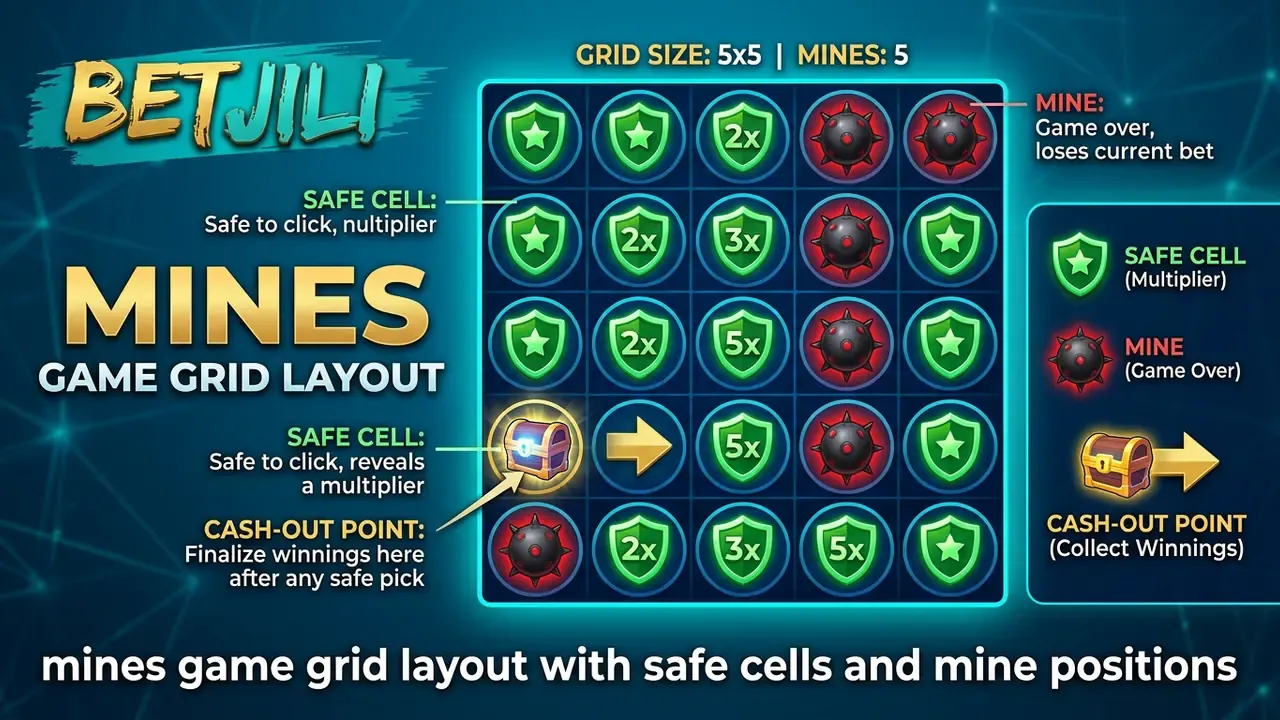
Every mines round follows the same flow, regardless of provider:
This sequence creates the defining psychological tension. With every safe reveal, the potential payout grows. But so does the statistical probability that the next tile hides a mine. The game is asking you one question, over and over: keep going or walk away?
The appeal is structural, not mysterious.
Speed. Rounds resolve in seconds. That matches the attention span of mobile users and fits neatly between live sports events.
Control illusion. Players choose which tile to click. This creates a feeling of agency — even though outcomes are purely random. No tile is safer than another. But it feels like a decision, and that feeling matters.
Low floor, high ceiling. Minimum bets as low as $0.20 coexist with theoretical maximum wins of x10,000. That range appeals to casual game players and more experienced ones alike.
Cash-out agency. Unlike slots, where you press spin and wait, mines requires an active decision to stop. If you already understand cashing out a live cricket bet when your team is ahead, the mines cash-out is the same mental model applied to a grid. Sports bettors find this intuitive.
Accessibility. The game loads on any browser. No complex rules to learn. No themed narratives to follow. Just a grid, a bet, and a choice. Among casino games, it is one of the simplest to understand — and one of the hardest to walk away from at the right moment.
"19.8% of Pennsylvania adults reported online gambling in the past 12 months; 2.7% met problem-gambling criteria." — Pennsylvania Online Gambling Report, 2024.
While that data comes from the US, the trend is instructive globally. As online gambling participation increases in regulated markets, instant-play titles like mines capture significant share. Short round durations and low minimum bets drive adoption among both casual players and sports bettors seeking quick entertainment.
Let's get practical. If you have never touched a mines game before, here is exactly what happens when you open one.
[FLOWCHART: Step-by-step path: choose bet → set number of mines → reveal tiles → continue or cash out. Alt text: "mines game flowchart showing player decision path"]
The process is the same whether you play mines through a browser, a PWA, or a downloaded APK. The interface may look slightly different across providers, but the core features remain consistent:
In Spribe's version, the interface shows the current multiplier before every click. That transparency lets players can make informed cash-out decisions. Hacksaw's implementation offers additional control through adjustable grid sizes — a 3×3 grid with 7 mines is a fundamentally different game from a 9×9 grid with 7 mines.
One thing worth flagging about auto-play specifically:
"Enabling auto-play in online casino games increased the total amount wagered by roughly 7–9% and the number of spins by about 3%, without changing net losses." — Experimental study on operator data, 2024.
Auto-play does not change your mathematical odds. But it does increase the speed at which you cycle through your bankroll. In mines specifically, auto-play combined with a high mine count can deplete funds significantly faster than manual play. Something to keep in mind.
The relationship between mine count and payout follows clear mathematical logic. More mines equals a higher multiplier per safe pick — but a lower probability of survival per click. Here is an illustration for a standard 5×5 grid:
| Mines on Grid | Safe Cells | Probability of Surviving Click #1 | Approximate Multiplier After 1 Safe Pick |
|---|---|---|---|
| 1 | 24 | 96.0% | ~1.04x |
| 3 | 22 | 88.0% | ~1.13x |
| 5 | 20 | 80.0% | ~1.24x |
| 10 | 15 | 60.0% | ~1.65x |
| 15 | 10 | 40.0% | ~2.47x |
| 20 | 5 | 20.0% | ~4.90x |
| 24 | 1 | 4.0% | ~24.0x |
Note: Exact multipliers vary by provider and incorporate the house edge. Figures above are illustrative, based on the probability formula (Total cells / Safe cells) adjusted for a typical 97% RTP.
The probability of surviving multiple consecutive clicks drops dramatically. On a 5×5 grid with 5 mines, the chance of safely revealing 5 consecutive tiles is approximately 0.80 × 0.79 × 0.78 × 0.76 × 0.75 ≈ 35.6%. With 10 mines, that same 5-click run drops to roughly 6.1%. This exponential decline is the fundamental mathematical reality every mines player must internalize.
Your grid choice, stake, and mine count together define the risk profile of every session. Adjusting any one of these parameters changes the game substantially.
There is no universally "correct" moment to cash out. But there are principles that help.
Early cash-out logic: If you set 3 mines on a 5×5 grid and reveal 2 safe tiles, your survival probability for the next click is still high — around 83%. But the multiplier at that point is modest. Cashing out early means smaller, more frequent wins. It extends your session and keeps variance low.
Late cash-out logic: Pushing for 5 or 6 safe reveals with 5+ mines on the grid chases larger multipliers. The math is against you — each additional click compounds the risk. But the payout, if you survive, grows meaningfully.
The honest answer? The best time to cash out is before you feel the urge to push further. That impulse — "just one more tile" — is where most losses happen. Setting a fixed cash-out rule before the round begins (say, "I always stop after 3 safe picks") removes the emotional decision from the moment. Players can test this discipline in demo mode first, which brings us to the next section.
Demo modes — also called free-play or practice modes — let you experience the mines game without risking real money. Most operators and independent game sites offer them. For a game this simple, you might wonder: what is there to test?
More than you think, actually.
"Approximately 65% of new online slot players use demo modes before staking real money; demo serves as a marketing funnel tool." — Industry analysis of demo versions in slot development, 2023.
That statistic applies to slots, but the principle holds for mines. Here is what methodical players can learn from a free mines session:
Volatility assessment. Run 50–100 rounds with fixed parameters. Observe how frequently wins and losses cluster. This gives you a feel for the rhythm of the game — something numbers alone cannot convey.
Speed calibration. Time how long each round takes from bet to cash-out. This helps estimate how many rounds per hour you will play, which is a critical input for bankroll planning. Mines rounds often take under 30 seconds. That means 100+ rounds per hour is easy to reach without realizing it.
Multiplier mapping. Test different mine counts to see how aggressively multipliers scale. The difference between 3 mines and 10 mines on a 5×5 grid is not just mathematical — it feels different.
Grid size experimentation (Hacksaw version). Compare the dynamics of a 3×3 grid versus a 9×9 grid with the same number of mines. The density of danger changes everything.
Cash-out discipline practice. Set a rule — "always cash out after 3 safe picks" — and track whether you can consistently follow it over 100 rounds. This is arguably the most valuable exercise in the mines demo game.
Auto-play behavior observation. Enable auto-play with fixed settings and notice whether the tempo accelerates your risk-taking impulses compared to manual play.
"Games with narrative components and bonus rounds show 20–30% higher retention; 57% of players prefer slots with interactive bonuses." — Industry report on online slots, 2023.
While mines lacks narrative depth, its interactive cash-out mechanic functions similarly by keeping the player actively engaged in every decision. That engagement is what makes the game sticky — and what makes demo practice genuinely useful.
Here is where honesty matters more than encouragement.
Demo play operates with virtual credits. No real money is at risk. This fundamentally changes how you make decisions — in ways most players underestimate.
"Players using no-deposit bonus funds placed bets 1.7 times more frequently and 30% higher in size than when wagering their own money, while rating their winning chances 20% higher." — International Gambling Studies, 2024.
A 2023 fMRI experiment found that ventral striatum activation — the brain region associated with reward processing — was 40% lower during bets placed with play money compared to real money. In plain terms: your brain does not register consequences the same way when nothing is at stake.
"Ventral striatum activation was 40% lower during play-money bets vs. real-money bets, indicating weakened perception of financial consequences." — Neuropsychopharmacology, 2023.
A meta-analysis of 28 studies confirmed that in risk-free gambling environments, players systematically overestimate their winning probability by 15–25% and underestimate loss frequency.
"Players overestimate winning probability by 15–25% and underestimate loss frequency in non-monetary settings." — Addiction Research & Theory, 2022.
The practical takeaway: Any approach that "works" in demo mode must be stress-tested against the psychological reality that you will make different — usually worse — decisions when real money is on the line. The mines demo is for learning mechanics and building habits. It is not for validating strategies.
Important: Bonus conditions, eligibility rules, and withdrawal restrictions vary between operators and jurisdictions. Always verify current terms on the offer page before claiming any bonus. The information below is general and does not replace reading the specific terms at the casino where you play.
Casino bonuses are marketing tools designed to reduce the perceived cost of your first engagement. In the context of the mines game, here are the most common bonus types you will encounter:
Welcome Bonus (Deposit Match). The operator matches a percentage of your first deposit. A "100% up to $100" welcome bonus means depositing $100 gives you $200 in total playable balance. These remain the most widespread sign-up incentive across online casinos.
"First-deposit bonuses remain the most widespread sign-up incentive; reload bonuses are gaining traction for retaining existing players." — Analysis of bonus evolution in digital betting platforms, 2023.
No-Deposit Bonus. A small amount of free play — typically $5–$20 — credited upon registration without requiring a deposit. These are designed as zero-friction trials. They let you experience the mines game with real-money mechanics but carry heavy wagering requirements.
Free Rounds. While traditionally associated with slots, some operators offer mines-specific free rounds as part of promotional packages. These function similarly to free spins but applied to the mines grid.
Cashback Offers. A percentage (typically 5–15%) of net losses returned to you over a period. These reduce the effective house edge but do not eliminate it.
Tournament and Leaderboard Prizes. Competitive events where players earn points based on wagering volume or multiplier achievements in mines, with cash prizes distributed to top finishers.
For new users, the mines game bonus — whatever its form — serves one primary function: it lowers the barrier to entry. You get to experience the real-money version of the game with reduced personal risk. That is the genuine value. Not guaranteed profit. Reduced initial exposure.
Think of it this way. Without a bonus, your first $50 deposit gives you exactly $50 to play with. With a 100% match, you have $100. That extra balance does not change the mathematics of the game — the house edge remains identical. But it does change your experience in two practical ways.
First, it extends your session. More balance means more rounds before depletion, which means more time to learn the rhythm of the game, practice cash-out discipline, and understand your own risk tolerance.
Second, it creates a psychological buffer. Research consistently shows that players behave differently when part of their balance comes from bonus funds:
"Players with welcome bonuses increased the share of bets on high-risk slots and 'all-or-nothing' wagers by 18–27% compared to pre-bonus behavior, with average bet sizes rising 12–15%." — Gambling Research Exchange Ontario, 2024.
"Players perceive bonus funds as a separate 'pocket' and are willing to take 20–25% more risk than with equivalent personal funds." — Journal of Economic Psychology, 2023.
This is a double-edged sword. The bonus gives you room to experiment — but it can also encourage riskier play than you would normally choose. Being aware of this effect is half the battle.
Accessing a mines game bonus in a regulated online casino follows a consistent flow in 2026:
[CHECKLIST: Steps to access the offer — login, check available bonus, claim, confirm conditions. Alt text: "mines game login and bonus claim checklist"]
Cryptocurrency payments are increasingly common in 2026. Casinos may accept crypto through digital wallets, crypto ATMs, stablecoins, and third-party payment processors. However, this introduces additional AML (Anti-Money Laundering) monitoring obligations.
"Casinos can accept crypto through digital wallets, crypto ATMs, stablecoins, and third-party providers; enhanced AML monitoring is required." — UNLV Report on Crypto Payments in Gaming, 2024.
Before you get frustrated by a rejected bonus, here are the most common obstacles — and they are almost always avoidable:
Incomplete KYC. This is the number one blocker. Upload clear, valid documents. Blurry photos or expired IDs will delay everything.
Geographic restrictions. The operator may not serve your country. Verify this before registering. Using a VPN to circumvent geo-blocks is universally prohibited and will result in account closure and forfeiture of any winnings.
Multi-accounting. Creating more than one account to claim bonuses multiple times is detected through IP, device fingerprint, and payment method analysis. It leads to permanent bans.
Exceeding maximum bet limits. Most bonuses cap your bet at $5–$10 per round while bonus funds are active. A single bet above this limit can void the entire bonus and any associated winnings.
Missing wagering deadlines. Failing to complete the required wagering volume within the specified time — usually 7 to 30 days — forfeits the bonus.
"UK Gambling Commission's Licensing Conditions and Codes of Practice (2023) require that promotional terms — including wagering requirements and which games contribute — must be clearly and prominently displayed before the customer can accept the offer." — UKGC LCCP, 2023.
Not all bonuses are created equal. Before committing, you can estimate the Expected Value (EV) of any offer:
EV Formula: EV = Bonus Amount − (Total Wagering Required × House Edge)
Worked example:
In this scenario, the bonus has negative expected value. You are statistically expected to lose more in required wagering than the bonus is worth. This does not mean winning is impossible — it means that over many identical scenarios, the average outcome is a net loss.
Positive EV bonuses do exist but are increasingly rare. They typically feature low wagering (under 15x), high game contribution for mines, and generous time limits. Identifying these requires calculating EV before claiming — not after.
Key conditions to verify before claiming any mines game bonus:
Every legitimate mines game uses a certified Random Number Generator to determine mine positions before the round begins. The RNG operates continuously, generating thousands of numbers per second even when idle. The moment you click "Bet," the RNG captures a number that maps to the mine layout for that round.
"RNG generates thousands of numbers per second even while idle; each outcome is a unique event independent of previous results." — Explanatory article on the role of RNG in online slots, 2024.
What this means in practice:
RTP (Return to Player) represents the theoretical percentage of wagered money returned to players over an extremely large number of rounds.
| Provider | Typical RTP Range | Notes |
|---|---|---|
| Spribe | ~96%–97% | Relatively fixed across platforms |
| Hacksaw Gaming | 94%–98% | Operator-configurable; varies by casino |
A 97% RTP means that for every $100 wagered over millions of rounds, the expected return is $97. The remaining $3 is the house edge. But this is a long-term statistical average. Individual sessions can — and will — deviate wildly.
Here is a table showing how game parameters interact with risk and payout:
| Game Parameter | What It Affects | Risk Impact | Payout Impact |
|---|---|---|---|
| Number of mines | Survival probability per click | More mines = higher risk per tile | More mines = higher multiplier per safe pick |
| Grid size (Hacksaw) | Mine density | Larger grid = lower density for same mine count | Larger grid = more safe picks available |
| Number of tiles revealed | Cumulative survival odds | Each additional reveal compounds risk | Each additional reveal increases multiplier |
| Cash-out timing | Realized vs. theoretical win | Later cash-out = higher chance of hitting a mine | Later cash-out = higher potential payout |
The relationship is always the same: higher possible payout comes with lower probability of achieving it. There is no configuration that offers both high reward and high safety. The game is designed so that the house edge applies regardless of your settings.
The maximum win multiplier in Hacksaw Gaming's mines is x10,000. Technically achievable. Practically? Almost never.
For an event with probability p ≈ 0.00001 (1 in 100,000), achieving even one such outcome requires approximately 100,000 attempts. For your results to converge on the mathematical expectation, you need on the order of 10 billion rounds.
In practical terms: a player making 100 bets per day at the maximum multiplier setting has a negligible chance of hitting x10,000 even over years of play. The expected value of each attempt is negative because of the house edge. The cumulative cost of pursuing the maximum multiplier far exceeds the expected payout.
Hacksaw Gaming's mines "was tested to be accurate over 10,000,000,000 simulations. Provably fair that is!" That volume of testing ensures statistical performance matches the declared rate.
But it also illustrates the scale at which these numbers operate — far beyond any individual player's lifetime of rounds.
The bottom line: Extreme multipliers exist as theoretical ceilings, not practical targets. They serve the same psychological function as lottery jackpots. They make the game exciting. Pursuing them as a strategy is mathematically self-defeating.
In cryptocurrency casinos, many mines implementations use the Provably Fair protocol. Before the round, the server generates a secret seed and shows you its cryptographic hash. After the round, the server reveals the original seed. You can verify the hash matches — confirming the outcome was predetermined and not altered mid-round. This mechanism ensures the casino cannot change mine positions after seeing your clicks. Any player can recalculate and verify any past round.
Let's start with the uncomfortable truth. No strategy can overcome the house edge. The edge is mathematically embedded in the payout multipliers. No sequence of clicks, no betting pattern, and no system converts a negative-expectation game into a positive one over time.
What strategy can do is manage the rate at which you engage with that edge. It controls volatility, reduces the likelihood of catastrophic bankroll loss, and — perhaps most importantly — keeps the experience enjoyable rather than stressful.
For beginners — conservative low-mine play:
For experienced players — disciplined fixed cash-out:
For high-variance seekers — aggressive high-mine play:
Pattern-based clicking — selecting tiles in a fixed sequence (corners first, edges, center) — offers no mathematical advantage. Mine positions are random. But it provides structure that prevents impulsive clicking, and that psychological benefit is real.
A word on Martingale. Doubling your bet after each loss sounds logical on paper. In practice, a 5-loss streak at a $1 base bet requires a $32 bet on round 6. A 10-loss streak requires $1,024 — which exceeds most table limits. Bonus terms typically cap bets at $5–$10, making Martingale functionally impossible during wagering.
"Progressive strategies like Martingale do not alter expected value and do not eliminate the risk of ruin, especially in the presence of bet limits and wagering requirements." — UK Gambling Commission methodology reviews, 2022–2023.
The single most impactful strategy is bankroll management:
Bonuses change behavior. The research is clear on this:
"When bonus credits represent 20%+ of the base balance, participants chose high-variance options significantly more often." — Journal of Behavioral Decision Making, 2023.
In mines specifically, this manifests as players choosing higher mine counts when playing with bonus money than they would with their own funds. The "mental accounting" effect — treating bonus money as less valuable — is well-documented and hard to resist.
Here are the most common mistakes:
Ignoring wagering requirements. Claiming a bonus without calculating its EV, then discovering the wagering cost exceeds the bonus value. Always do the math first.
Neglecting game contribution rates. Playing mines to clear a bonus when the game only contributes 10% to wagering requires 10x more actual betting volume than you expected. A $10 mines bet might count as only $1 toward your wager.
Confusing demo results with real-money expectations. Approaches that seem successful in free mines may fail under the psychological pressure of real stakes. Your brain processes risk differently when money is real.
Playing too aggressively on bonus funds. The temptation to "go big" because it is "not really your money" leads to faster depletion and missed wagering targets.
Tax ignorance. In the United States, all gambling winnings are taxable income. Losses can only offset winnings through itemized deductions, up to the amount of winnings reported.
"All gambling winnings are taxable income in the United States; losses are deductible only up to the amount of winnings when itemizing deductions." — IRS Topic 419, current edition.
Exceeding intended time. Set a timer. The speed of mines rounds — often under 30 seconds each — makes it easy to play hundreds of rounds in an hour without realizing it.
In 2026, you can play mines through three primary channels. The right choice depends on your situation and preferences.
HTML5 Browser Play (the dominant method). Works on any modern browser — Chrome, Safari, Firefox, Edge — on desktop or mobile. No download required. The game loads directly from the casino website. Always up to date, no storage space needed. The limitation: you need a stable internet connection, and performance depends on your browser.
Progressive Web Apps (PWA). Lightweight web versions you can install from the browser with an "Add to Home Screen" option. They provide an app-like experience without a traditional app store download. Smaller than native apps, work across platforms. But push notification support is limited, payment system integration is weaker, and no offline play is available for real-money games. Currently used by less than 5% of mobile gaming distribution.
Standalone APK / Native Apps. Downloadable through Google Play, Samsung Galaxy Store, Huawei AppGallery, or direct APK files from operator websites. Over 90% of commercial mines-type games use standalone APK or AAB formats. Full platform integration, push notifications, potentially smoother performance. The trade-off: requires storage space, updates through app stores, and geo-restrictions may apply.
For most players, browser-based play remains the simplest option. The HTML5 standard ensures consistent performance across devices. You can play mines anytime, anywhere, without managing app versions or worrying about storage.
The mines game APK makes sense in specific scenarios: if you play frequently and want push notifications for new bonuses, if your mobile browser struggles with performance, or if you prefer the feel of a dedicated app. The mines game download is straightforward from official sources — but always verify you are downloading from the operator's legitimate website or an authorized app store. Third-party APK sources carry security risks.
One practical consideration for users in Bangladesh and similar markets: bandwidth can be inconsistent. Browser-based play requires a connection for every round. An APK may load faster once installed, since core assets are stored locally. But the actual game logic — the RNG, the bet processing, the payout — always runs server-side. You cannot play for real money offline regardless of format.
Respuestas renderizadas en formato acorde al diseГ±o exportado: tarjetas oscuras, acento dorado y despliegue compacto.
This article provides general information about the mines casino game and does not constitute financial, legal, or gambling advice. Gambling involves risk of financial loss. Past results do not predict future outcomes. Play responsibly and within your means.